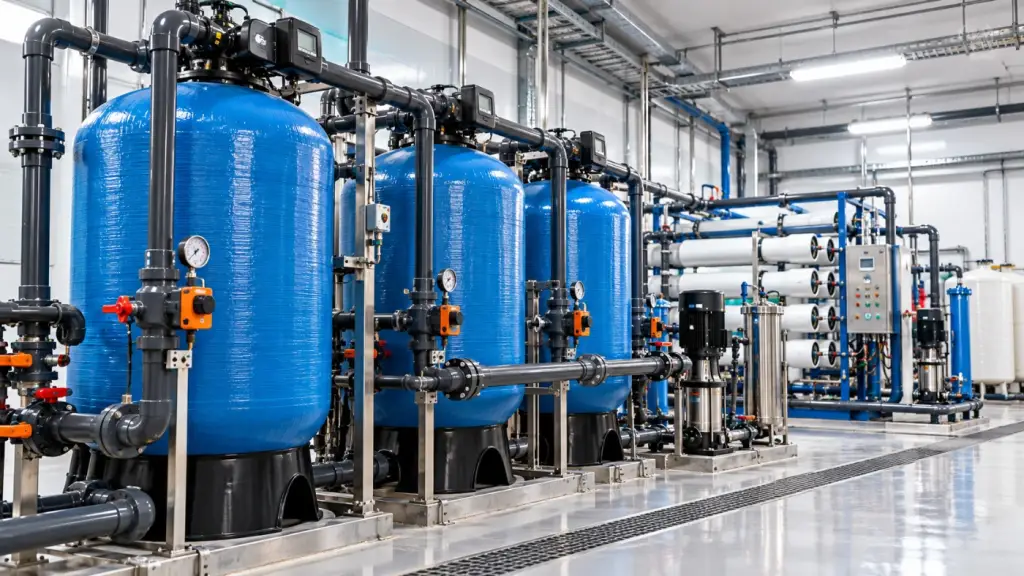
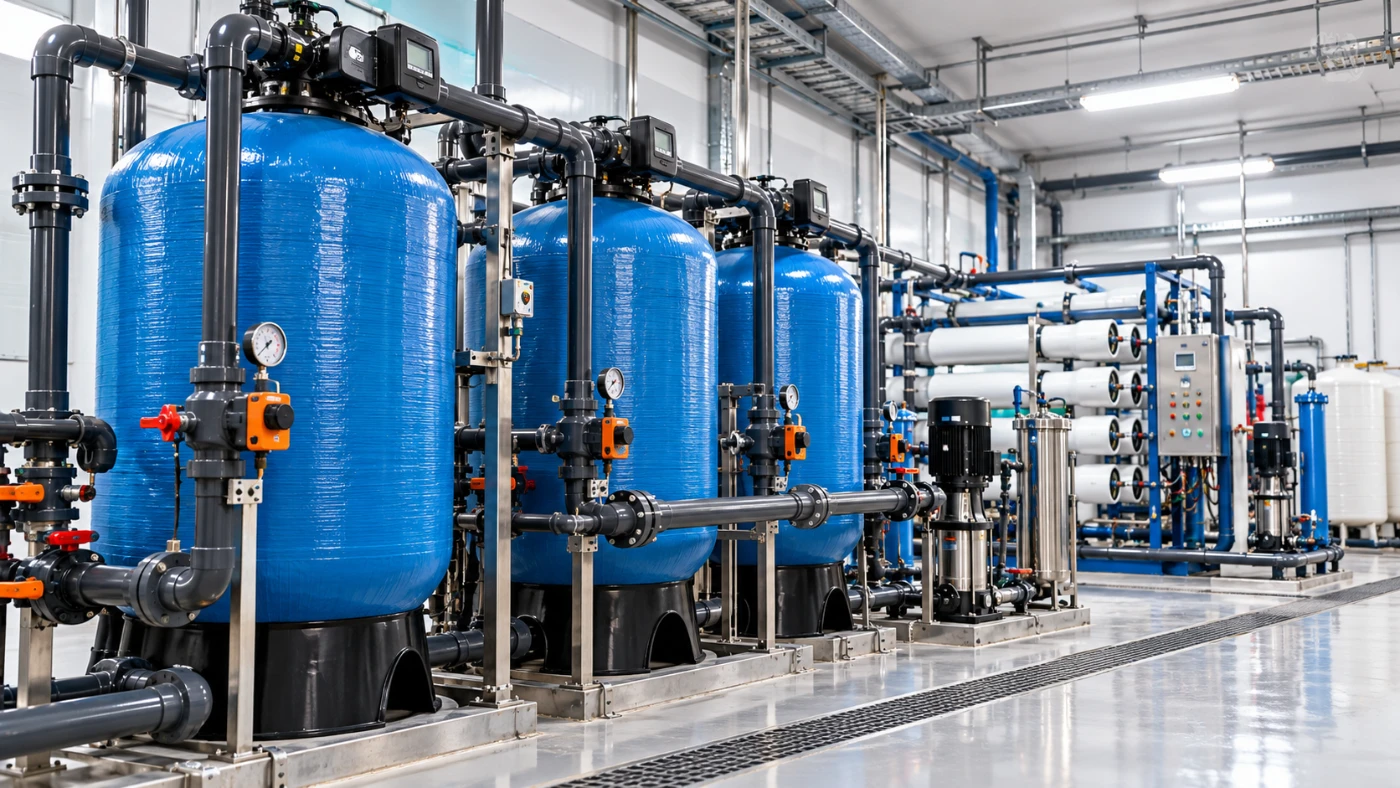
A sand filter is a pressure vessel filled with graded layers of gravel and sand. Water passes through it from top to bottom, and turbidity and suspended solids are trapped between the sand grains. It is used in factories and water plants as pre-treatment ahead of softeners and reverse osmosis plants, or as sufficient treatment for utility water. It is cleaned by backwashing when the pressure drop across it rises.
How does a sand filter work?
Water enters at the top of the vessel and is distributed over the surface of the sand, then passes down through the layers. Suspended particles are trapped in the upper part of the sand and between its grains, and the filtered water leaves through a bottom collector (strainers) surrounded by the gravel layer, which supports the sand and stops it escaping. Over time the voids fill with deposits and the pressure drop between inlet and outlet rises; this is when backwashing is due.
What does a sand filter consist of?
- The vessel: fibreglass (FRP) for small and medium sizes, or lined steel for large sizes.
- The media: layers of graded gravel and then filter sand with graded grain sizes.
- A top distributor and a bottom collector with fine strainers.
- A control head or valves: manual or automatic, carrying out the service, backwash and rinse cycles.
- Pressure gauges on the inlet and outlet to follow the pressure drop.
What is the difference between sand, multimedia and carbon filters?
| Type | Media | What it removes | Typical use |
|---|---|---|---|
| Sand filter | Gravel + sand | Turbidity and coarse and medium suspended solids | General pre-treatment |
| Multimedia filter | Layers graded by density (such as anthracite, sand and garnet) | Finer suspended solids, with a higher loading capacity | Ahead of RO plants and for high-turbidity water |
| Carbon filter | Activated carbon | Free chlorine, odours and organic matter | After the sand filter and ahead of membranes or resin |
| Iron removal filter | Birm or similar media | Dissolved iron and manganese | Well water |
For a detailed comparison read: Types of industrial water filters and how to choose the right filtration system.
When and how is a sand filter backwashed?
Backwashing is carried out when the pressure drop across the filter rises above its clean value by the amount the designer specifies (usually in the region of 0.5 to 1 bar), or at fixed time intervals, whichever comes first. The steps are:
- Backwash: water is pushed from bottom to top at a flow sufficient to expand the sand bed and flush the deposits to drain, for several minutes until the drain water runs clear.
- Forward rinse: water is passed in the service direction to drain for a few minutes, to resettle the bed and flush out the remaining turbidity.
- Return to service.
A weak backwash flow does not clean the bed, and one that is too strong flushes out the sand itself; so it is set according to the size of the vessel and the type of media.
When is the sand media replaced?
- Turbidity in the outlet water despite good backwashing.
- The pressure drop rising again quickly after backwashing.
- The sand clumping into mud balls, or channels forming through which water passes unfiltered.
- A lower media level because sand has been lost during backwashing.
- Sand appearing in the product water (which also points to damaged bottom strainers).
The life of the media usually runs to years, and is shorter with water that is highly turbid or contains iron or oils.
What are the common operating mistakes?
- Running the filter at a flow above its design, so that suspended solids pass through.
- Putting off backwashing until the sand clumps.
- Using sand that is ungraded or not intended for filters.
- Neglecting to read the pressure gauges.
Sand filter FAQ
Does a sand filter remove salts or hardness?
No. It removes suspended solids only. Hardness needs a softener, and salts need reverse osmosis.
Do I need a sand filter ahead of an RO plant?
In most cases yes, followed by a carbon filter and a cartridge filter, to protect the membranes from turbidity and chlorine.
How often is the filter backwashed?
It depends on the turbidity of the water: from once a day for turbid water to once every few days for clean water. The reference is the pressure drop.
Can the filter be backwashed with raw water?
Usually yes, as long as the water has enough pressure and flow. In some systems filtered water is preferred.
Summary
A sand filter that is correctly designed and backwashed protects everything that comes after it in the plant. Learn about Aqua System filtration units, or browse filter media: sand, gravel, carbon and Birm.
Want your system reviewed? Contact the Aqua System technical team and send your water analysis if you have one — we will come back with a suitable solution and a clear quotation.