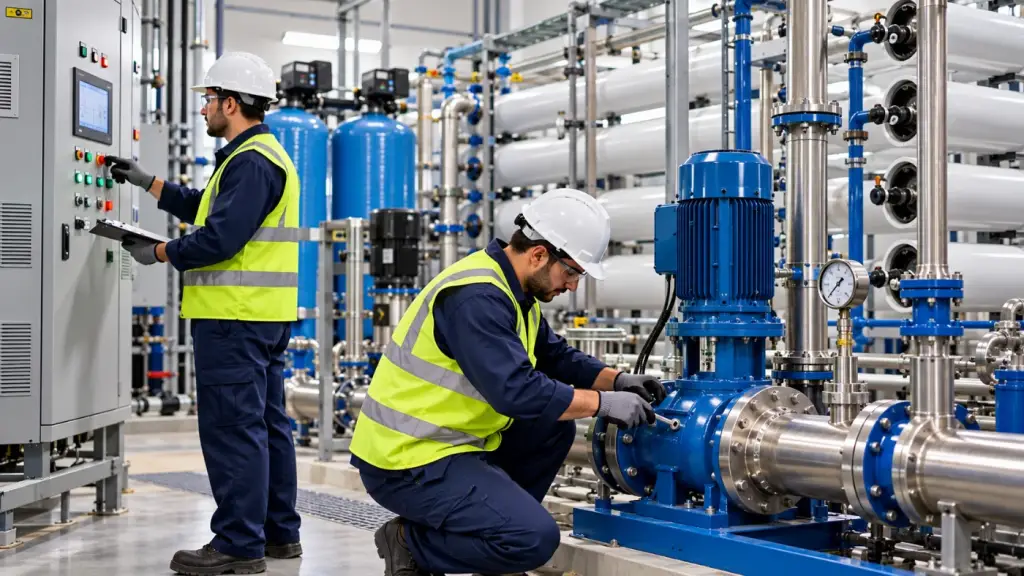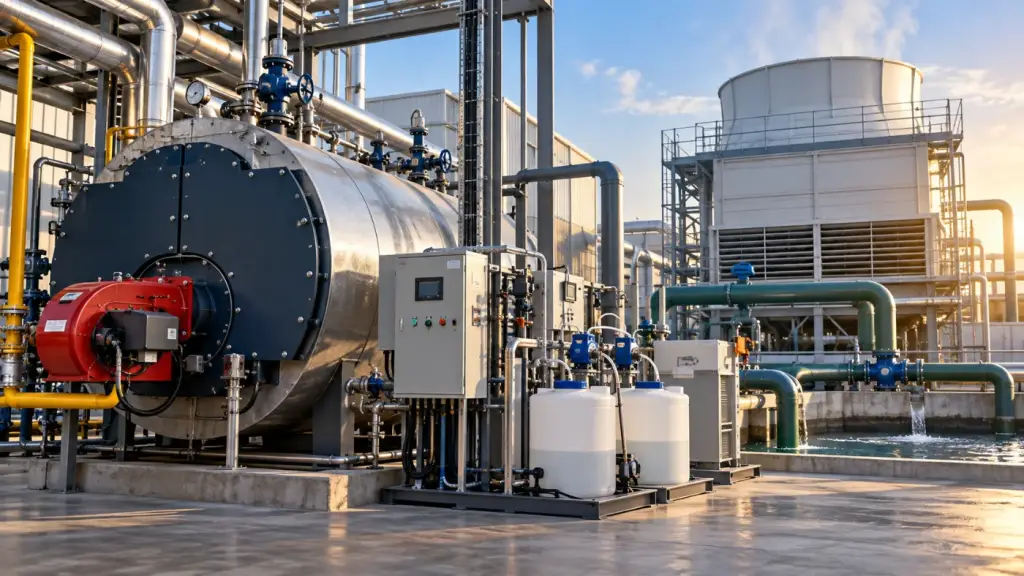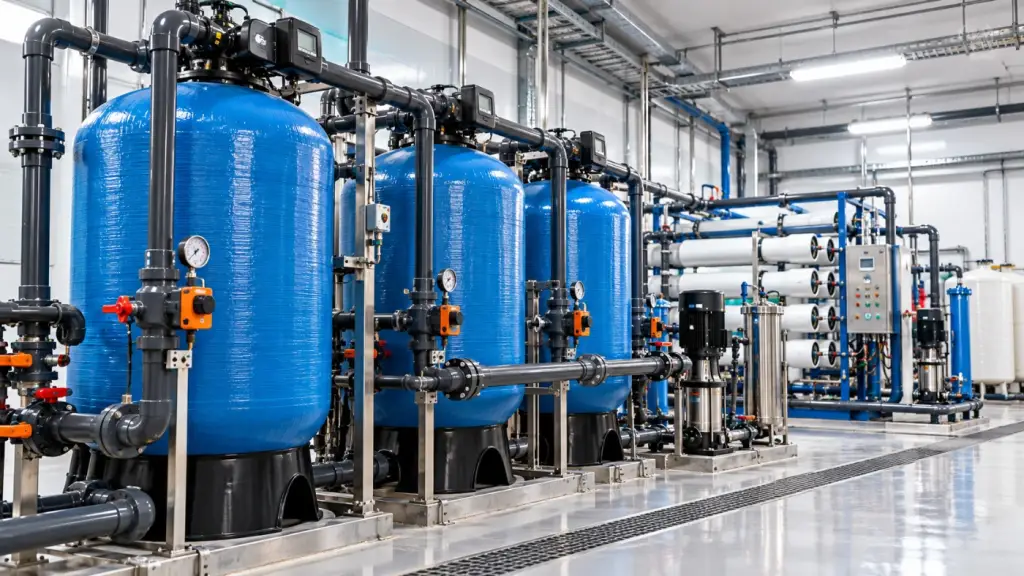
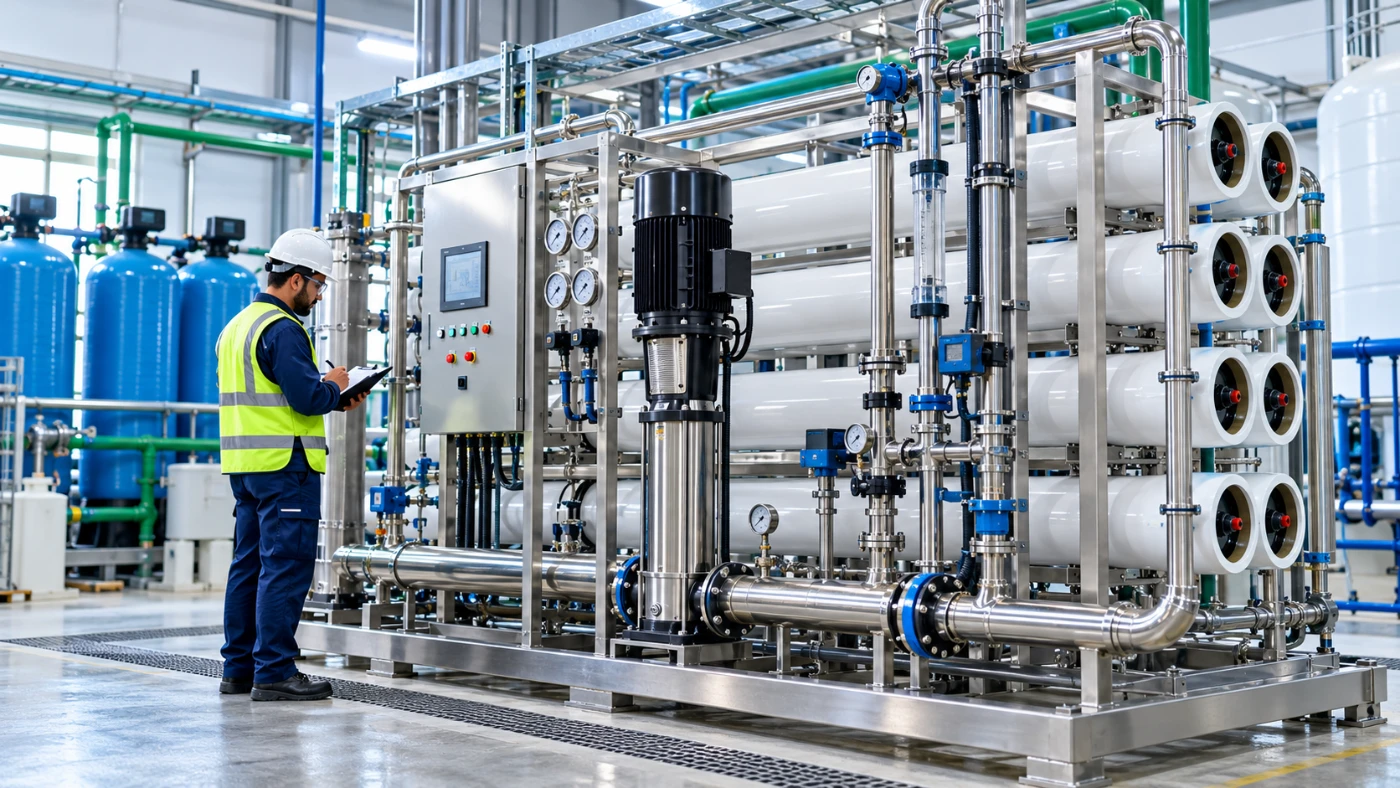
RO desalination plant chemicals are the products dosed ahead of the membranes to protect them (antiscalant, dechlorinator, pH adjuster), those used periodically to clean them (alkaline and acid cleaners), and those added after them to condition the product water (pH adjustment and disinfection). The membranes are the most expensive components of the plant, and these chemicals are what determine their life and the stability of their output.
What chemicals are used in reverse osmosis desalination?
| Stage | Chemical | Function |
|---|---|---|
| Before the membranes | Chlorine (when needed) | Disinfect the feedwater and prevent biological growth in the pre-treatment |
| Coagulant (when needed) | Gather fine suspended particles to improve filter performance | |
| Dechlorinator | Remove free chlorine ahead of the membranes, because it damages polyamide membranes | |
| Antiscalant | Prevent calcium carbonate, calcium sulphate, silica and other salts depositing on the membrane surface | |
| Periodic cleaning (CIP) | Alkaline cleaner and acid cleaner | Remove organic and biological deposits, then scale and metal oxides |
| After the membranes | pH adjuster (such as caustic soda) | Raise the pH of the product water, which tends to be acidic |
| Final disinfection | Keep the water safe in the tank and the network |
What does the antiscalant do and how is it chosen?
Membranes pass water and hold back salts, so the salt concentration on the concentrate side rises until it exceeds the solubility limit and the salts start to deposit. An antiscalant delays this deposition with a small continuous dose, which allows the plant to run at an economical recovery rate.
The choice depends on the water source: brackish well water differs from seawater in its salts. That is why Aqua System offers Aquaguard-BW for well water and Aquaguard-SW for seawater. The dose is calculated from the water analysis and the recovery rate. Details are in the RO antiscalant guide.
Why is chlorine removed ahead of the membranes?
Most modern RO membranes are made of polyamide, which is damaged irreparably by exposure to free chlorine, so that salt passage rises. Chlorine is therefore removed with an activated carbon filter or by dosing a reducing agent, and chlorine is monitored ahead of the membranes with a chlorine test kit.
When do RO membranes need chemical cleaning?
Membrane manufacturers usually recommend cleaning when one of three indicators changes, after correcting them for temperature and pressure (normalised values):
- Product water flow falls by about 10–15%.
- Salt passage (product water conductivity) rises by about 10–15%.
- The pressure drop between feed and concentrate rises by about 15%.
Delaying cleaning makes the deposits harder to remove and may damage the membranes. Check your membrane manufacturer’s recommendations for the exact values.
How do you identify the type of fouling and the right cleaner?
| Type of fouling | Usual signs | Cleaner |
|---|---|---|
| Scale (carbonates, sulphates) | Appears first in the last stage; higher salt passage and lower output | Acid (low pH) |
| Iron and metal oxides | Appear in the first stage; brown deposits on the cartridge filters | Acid |
| Organic and colloidal matter | Appears in the first stage; higher pressure drop | Alkaline (high pH) |
| Biological growth | A rapid rise in pressure drop; a slimy layer and an odour | Alkaline, then disinfection with a product compatible with the membranes |
When more than one type is present, cleaning usually starts with the alkaline cleaner and then the acid.
What are the steps of chemical cleaning (CIP)?
- Prepare the cleaning solution with product water (not hard water) in the cleaning tank, and adjust the pH and temperature within what the membrane manufacturer allows.
- Circulate the solution through each stage separately, at a low flow and then a higher one, sending the first, dirty portion to drain.
- Soak the membranes for a period, then circulate again.
- Rinse thoroughly with product water until the pH and conductivity return to normal.
- Restart the plant and record the new readings to compare them with those before cleaning.
RO plant chemicals FAQ
Does an antiscalant replace membrane cleaning?
It greatly reduces the need for it but does not eliminate it; periodic cleaning is still necessary to remove the organic and biological deposits that build up slowly.
How often are membranes cleaned?
By the indicators, not the calendar. A plant with good pre-treatment may need cleaning a few times a year, and a plant that needs cleaning every month usually has a problem in its pre-treatment or its dosing.
Why do the cartridge filters change colour quickly?
It is a sign of iron, suspended solids or biological growth getting past the pre-treatment, and calls for a review of the sand and carbon filters before the problem reaches the membranes. Browse cartridge filters.
Can any acid or alkali be used to clean the membranes?
No. The pH and temperature limits are set by the membrane manufacturer, and exceeding them damages the membranes. Dedicated cleaners or approved formulations are used.
Summary
Protecting the membranes starts ahead of them: good pre-treatment and a suitable antiscalant, then cleaning at the right time. Browse reverse osmosis plant chemicals or learn about our RO desalination plant service.
Want your system reviewed? Contact the Aqua System technical team and send your water analysis if you have one — we will come back with a suitable solution and a clear quotation.