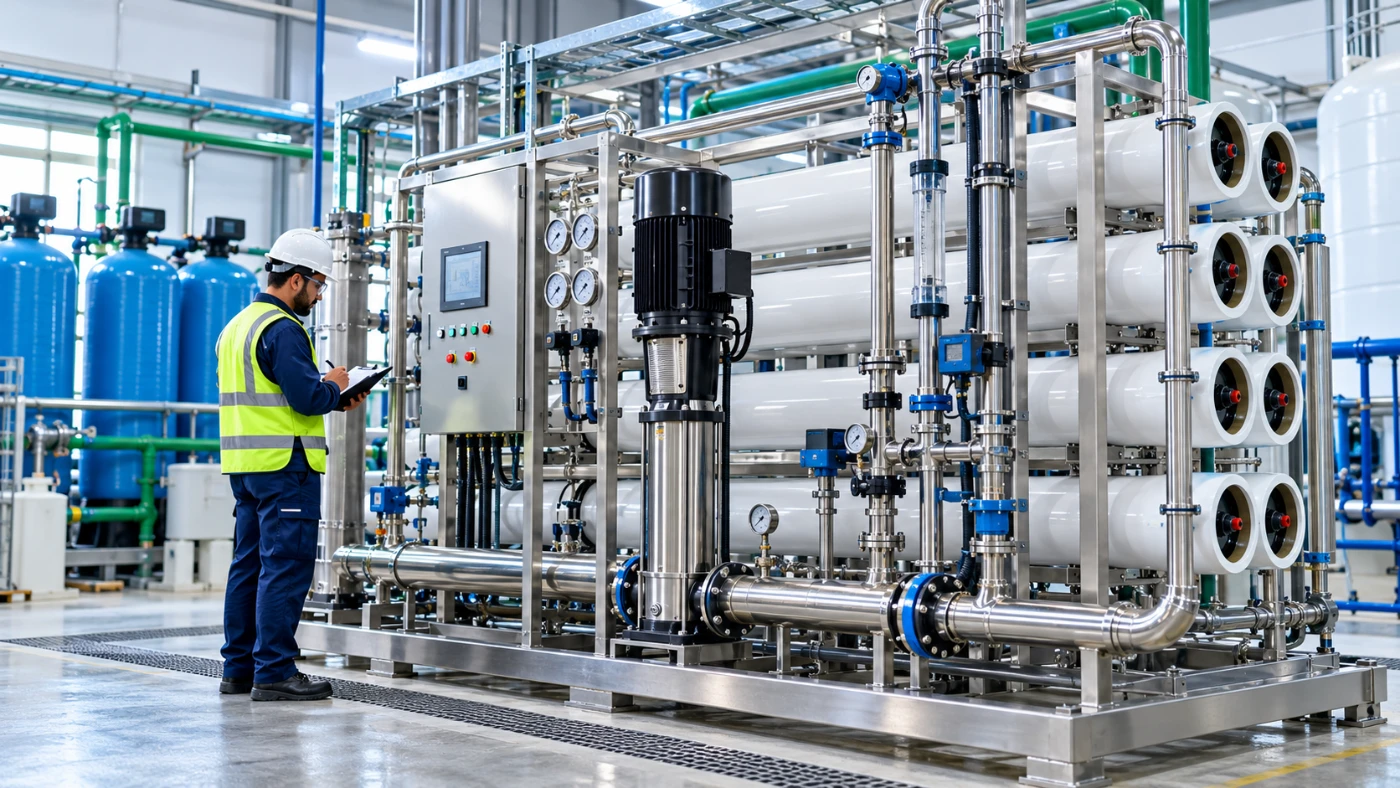
Inside reverse osmosis membranes the water concentrates progressively as it passes through. As it does, some salts — calcium carbonate, sulphates, silica — can exceed their solubility and start to precipitate on the membrane surface. The result: lower output, rising operating pressure and frequent chemical cleaning.
What does an antiscalant do?
An antiscalant is dosed continuously, in small amounts, into the feed ahead of the membranes. It interferes with the growth of salt crystals and lets the plant operate at higher concentrations without scaling. It is usually dosed after the cartridge filters and before the high-pressure pump.
Brackish water vs seawater: why the choice differs
Brackish well waters vary widely: some are rich in hardness, others in silica or iron, and their plants may run at high recovery. Seawater is far saltier, and seawater plants run at higher pressure and different recoveries. That is why we use Aquaguard-BW for brackish-water plants and Aquaguard-SW for seawater desalination.
How is the dose calculated?
The dose is not a fixed number. It is calculated from the feed-water analysis, the recovery and the plant design, then followed through the operating indicators: output, pressure drop across the membranes and permeate quality.
Table: antiscalant for brackish well water vs seawater
| Item | Brackish well water | Seawater |
|---|---|---|
| Total dissolved solids | Moderate, varying from well to well | Very high and relatively constant |
| Main scaling salts | Calcium carbonate and sulphate, silica, sometimes iron | Carbonate and sulphate at higher recoveries |
| Typical recovery | Higher | Lower |
| Suitable product | Aquaguard-BW | Aquaguard-SW |
Antiscalant FAQ
Can an RO plant run without an antiscalant?
With most well water and seawater, no — except at very low recoveries. Without an antiscalant the membranes scale quickly and output falls.
Does a higher dose protect the membranes better?
No. Overdosing can itself foul the membranes and adds cost. The dose is calculated from the water analysis and the recovery.
When do membranes need cleaning even with an antiscalant?
When output falls, or differential pressure or salt passage rises. See our guide to RO plant chemicals and membrane cleaning.
Part of a system
An antiscalant cannot make up for weak pre-treatment. Suspended solids, chlorine and iron need proper filtration before the membranes, and cartridge filters must be changed on time. Learn about the reverse osmosis plants we build or browse our RO plant chemicals.