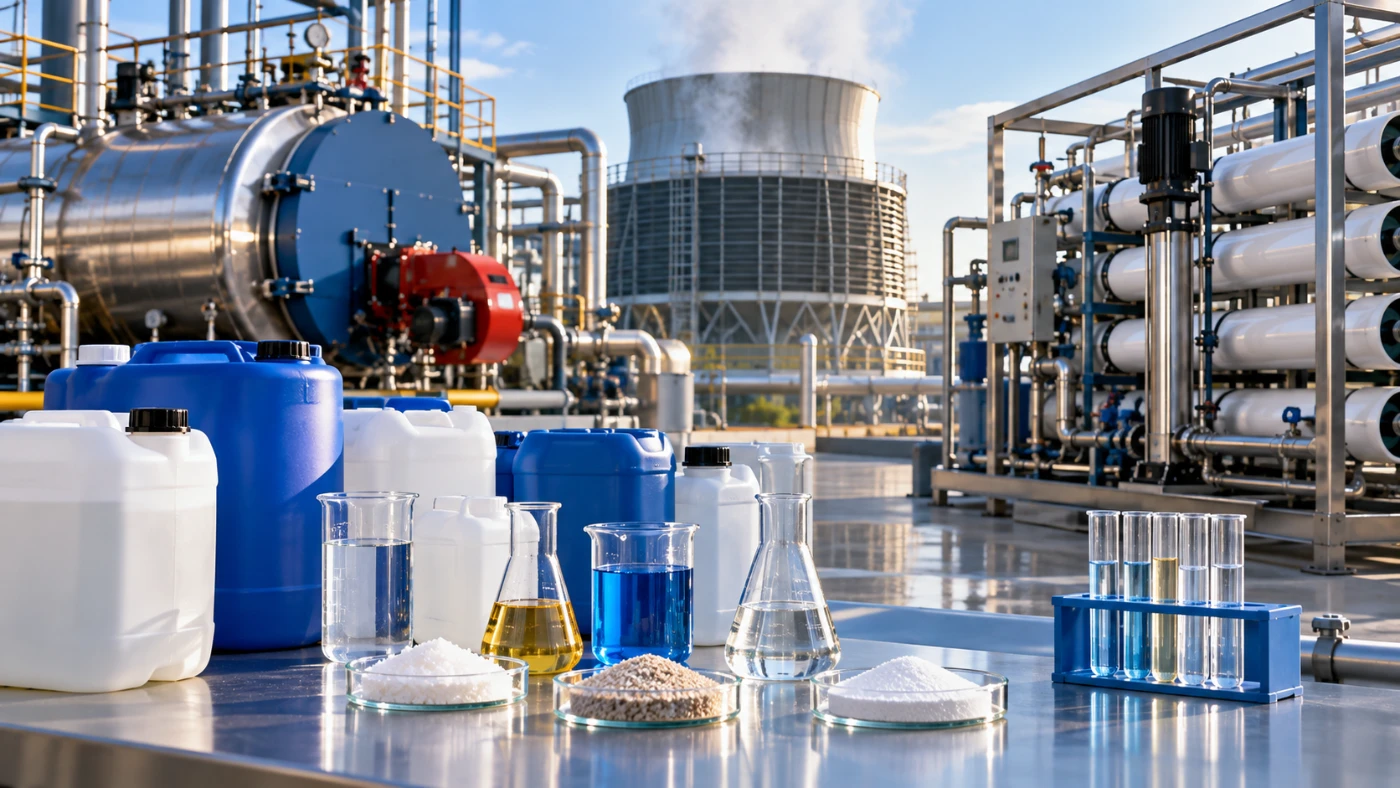
Cooling tower biocides are chemicals that control the growth of algae, bacteria and fungi in the tower water. Warm water exposed to air and sunlight is an ideal environment for this growth, which forms a slimy layer (biofilm) that blocks the fill, insulates the heat-exchange surfaces and causes corrosion beneath it, and may harbour Legionella bacteria, the cause of a serious respiratory disease. Effective control combines two different biocides used alternately with mechanical cleanliness and routine monitoring.
Why is biological growth the most serious cooling tower problem?
- It wastes energy: biofilm is a stronger thermal insulator than scale of the same thickness.
- It causes corrosion: localised corrosion cells develop under the slime layer, and some bacteria produce acids that attack the metal.
- It blocks the system: algae block the distribution nozzles, the fill and the strainers.
- It weakens the other chemicals: biofilm shields what lies beneath it from corrosion inhibitors and from the biocides themselves.
- It is a health risk: drift leaving the tower may carry Legionella to workers and people nearby.
What is Legionella and why is it linked to cooling towers?
Legionella is a bacterium found naturally in water. It multiplies in warm water that is stagnant or rich in deposits and biofilm, conditions that are present in a neglected cooling tower. Infection is transmitted by inhaling contaminated spray, not by drinking. Prevention relies on a regular biocide program, a clean basin and fill, avoiding stagnant water in unused lines, and drift eliminators in sound condition.
What types of biocides are there?
| Type | How it works | Advantages | Limitations |
|---|---|---|---|
| Oxidising biocides (such as chlorine, bromine and their compounds) | Oxidise the cell wall and kill quickly | Fast, broad action; low cost; easy to measure with a test kit | Affected by pH and organic matter; an excess increases corrosion and attacks some inhibitors |
| Non-oxidising biocides | Disrupt vital functions inside the cell by different mechanisms | Penetrate biofilm better, effective against algae and resistant bacteria, do not cause corrosion | Need a longer contact time and are added in batches at a set concentration |
| Biodispersants | Break up the slime layer and expose the organisms to the biocide | Raise the effectiveness of the biocides and clean the surfaces | Not a biocide in themselves; used together with the biocide |
Why are two biocides used alternately?
Micro-organisms adapt to a single biocide if they are exposed to it continuously, and the species resistant to it survive and multiply. Alternating between two biocides with different modes of action – as with AquaB1 and AquaB2 – covers a wider range of organisms and prevents this adaptation. The alternation schedule (weekly, for example) and the dose are set according to the system water volume and the monitoring results.
What does a biological control program consist of?
- Regular biocide doses: on a fixed schedule, not only when algae appear.
- A shock dose: at start-up after a shutdown, or when the bacterial count rises.
- Mechanical cleanliness: cleaning deposits out of the basin, washing the fill, and covering the basin from the sun where possible.
- Control of suspended solids: side-stream filtration and dispersants, because deposits are shelter and food for bacteria.
- Avoiding stagnation: circulating standby lines and equipment periodically.
- Compatibility with the scale and corrosion program: such as Aqua-CT 101, so that neither weakens the other.
How is biological growth monitored?
- Visual inspection: the colour of the water, algae on the fill and walls, a slimy feel to the surfaces.
- Free chlorine or biocide level: with on-site test kits, to confirm the dose is reaching the system.
- Total bacterial count: periodically, to follow the trend.
- Legionella testing: in a specialised laboratory, according to the facility’s risk management plan.
Cooling tower biocides FAQ
Does clear water mean the tower is biologically clean?
No. Most bacteria live inside the biofilm on the surfaces, not in the water itself, and the water can be clear while the fill is covered with a slime layer.
Is chlorine alone enough?
Chlorine is useful, but it weakens as pH rises and does not penetrate biofilm well. That is why it is supported by a non-oxidising biocide and a biodispersant.
When do I need a shock dose?
After a long shutdown, after cleaning the tower, when algae or an odour appear, or when the bacterial count rises above normal.
Are biocides dangerous for workers?
They are chemicals that are handled according to the safety data sheet: gloves and goggles, closed storage, and dosing by pump instead of manual addition wherever possible.
Summary
Biological control in a cooling tower is a continuous program: two alternating biocides, cleanliness and monitoring. Read the cooling tower water treatment guide, browse cooling tower chemicals, or learn about our treatment and follow-up service.
Want your system reviewed? Contact the Aqua System technical team and send your water analysis if you have one — we will come back with a suitable solution and a clear quotation.