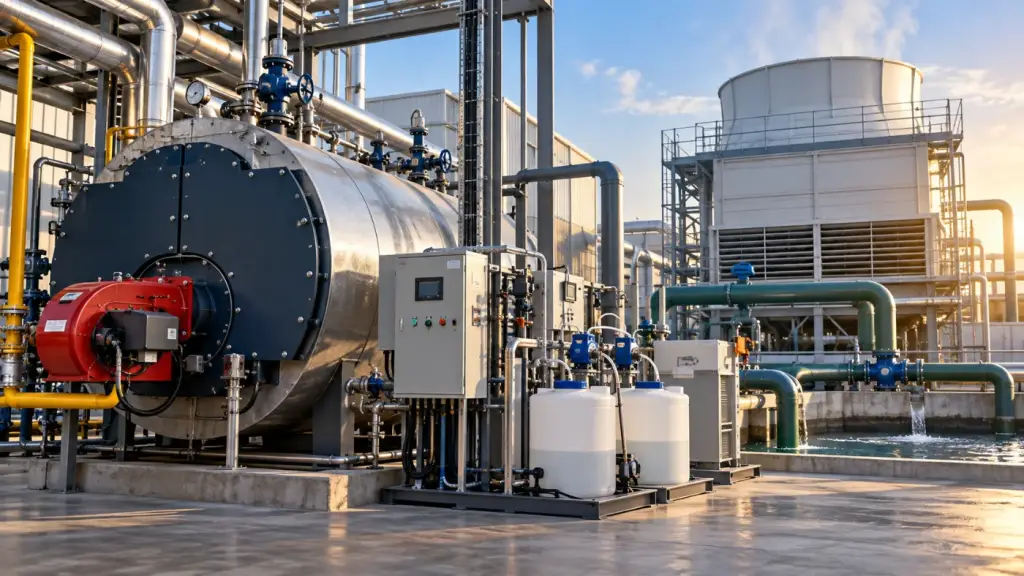
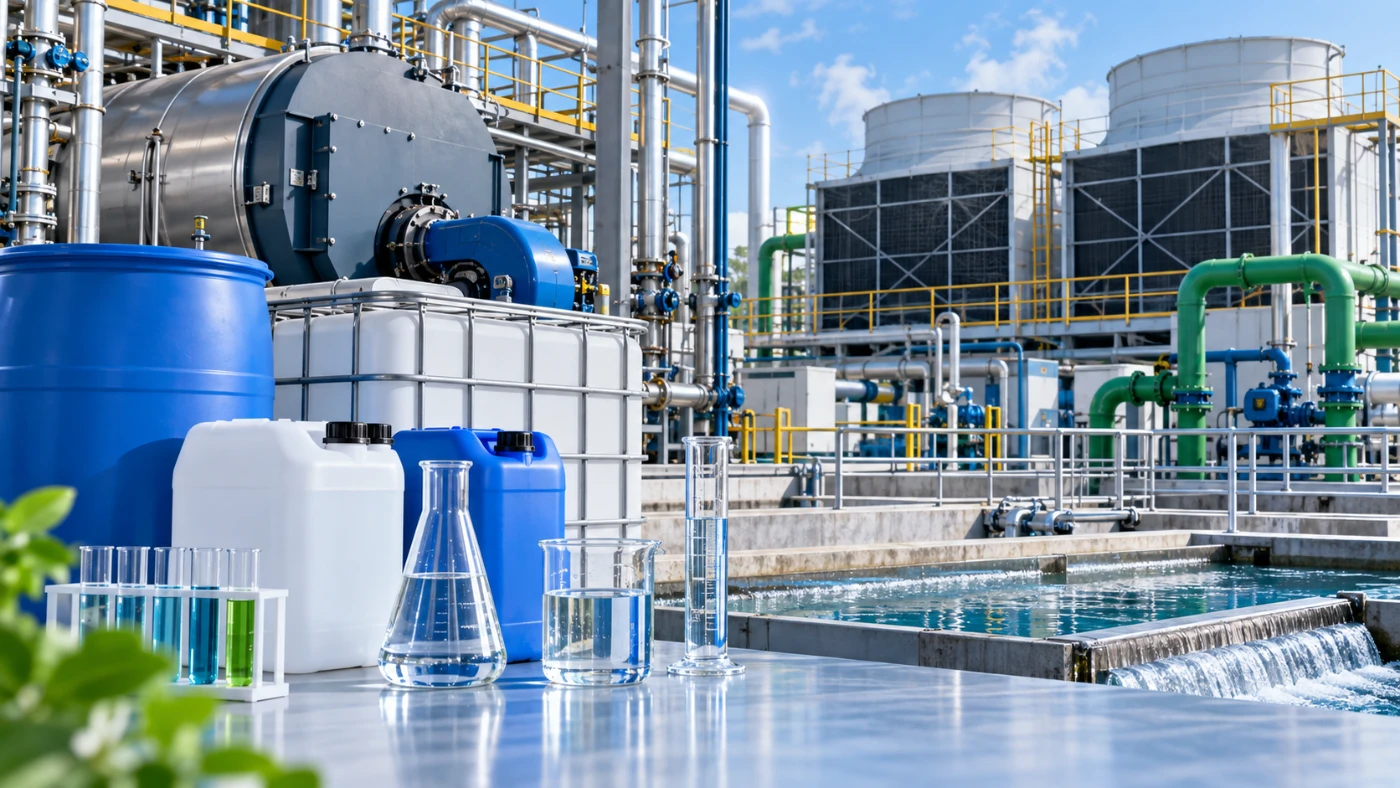
Boiler scale and corrosion inhibitors are chemicals dosed into the feedwater or into the boiler itself to prevent scale forming on the heating surfaces and to protect the metal from corrosion. A boiler program usually consists of four complementary functions: preventing scale, removing oxygen, controlling alkalinity, and protecting the steam and condensate lines. The dose is set from the feedwater analysis, the boiler pressure and the blowdown rate.
Why does a boiler need chemicals even when there is a softener?
A softener removes most of the hardness, but it does not remove dissolved oxygen, alkalinity or silica, and a small amount of hardness always passes through it and concentrates inside the boiler as the water evaporates. The chemicals deal with what is left: they stop the leaked hardness from depositing, remove the oxygen, and keep the water chemistry in the range that is safe for the metal.
What types of boiler water treatment chemicals are there?
| Type | Function | Notes |
|---|---|---|
| Phosphate scale inhibitors | Convert leaked hardness into soft, non-adherent sludge that leaves with the blowdown | Need controlled alkalinity and a sludge dispersant |
| Polymer inhibitors and dispersants | Keep salts and sludge in suspension and stop them sticking to the heating surfaces | Used alone or with phosphate. Examples: Aqua-Tn1 and Aqua-Tn2 and sludge dispersants |
| Oxygen scavengers | React with dissolved oxygen to prevent pitting corrosion | Dosed into the feed tank; the residual is monitored by testing |
| Alkalinity builders | Raise the boiler water pH into the range that protects the steel | An excess causes foaming and water carryover with the steam |
| Condensate treatment | Neutralise condensate acidity and protect the steam and return lines | Such as Aquasteam-N and Aquasteam-F |
| Combined products | Combine more than one function in a single product to simplify dosing | Such as the Aqua-SL scale and corrosion inhibitor |
How is the boiler chemical dose set?
- Feedwater analysis: leaked hardness, alkalinity, total dissolved solids, and the feed tank temperature (the higher it is, the less dissolved oxygen).
- Operating conditions: boiler pressure, steam output, and the proportion of condensate returned.
- Blowdown rate: it determines how many times the water concentrates inside the boiler, and therefore the concentration of the chemicals in it.
- Target limits: each reading (pH, alkalinity, oxygen scavenger residual, inhibitor level, conductivity) has a range that the program sets according to the boiler pressure and the manufacturer’s recommendations.
So the dose is not a fixed number on the container; it is a value calculated for the system and then adjusted by testing.
Where and how are the chemicals dosed?
- Oxygen scavenger: into the feedwater tank or the suction line, so that it has time to react before the boiler.
- Scale inhibitor and alkalinity builder: into the feed line after the pump, or directly into the boiler.
- Condensate treatment: into the steam line or with the feedwater, depending on the type of product.
- Continuous dosing with a dosing pump in proportion to the feed is better than manual addition in batches.
How do you confirm the dose is correct?
By routine testing of the boiler water, feedwater and condensate: oxygen scavenger residual, inhibitor level, pH and alkalinity, conductivity, and iron in the condensate. Details are in our guide to boiler and cooling tower water analysis.
Boiler chemicals FAQ
What is the difference between a scale inhibitor and a descaler?
A scale inhibitor prevents scale from forming during operation. A descaler (acid cleaning) is used to dissolve scale that has already formed, with the boiler shut down. Read: chemical cleaning of boilers.
Does a higher dose give better protection?
No. An excess raises the salts and alkalinity inside the boiler, which causes foaming and water carryover with the steam, and increases cost and blowdown. The aim is to stay within the specified range.
Are the same chemicals suitable for all boilers?
No. The program differs with the pressure, the type of boiler, the feedwater quality and how the steam is used, especially if the steam comes into contact with a food product.
What if chemical dosing stops for a period?
Scale and corrosion start to form with no immediate symptoms, and show up later as higher fuel consumption or a leak. That is why a reserve stock and a check on the level of the dosing tanks are recommended.
Summary
A successful boiler program combines four functions and is controlled by testing, not guesswork. Browse Aqua System boiler chemicals, learn about our boiler and cooling tower water treatment service, or read the boiler water treatment guide.
Want your system reviewed? Contact the Aqua System technical team and send your water analysis if you have one — we will come back with a suitable solution and a clear quotation.