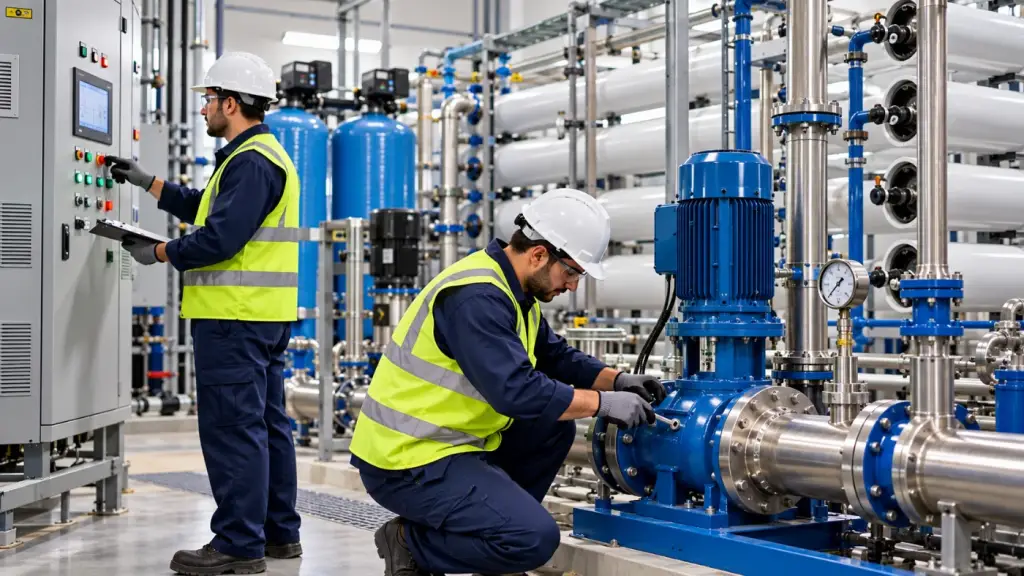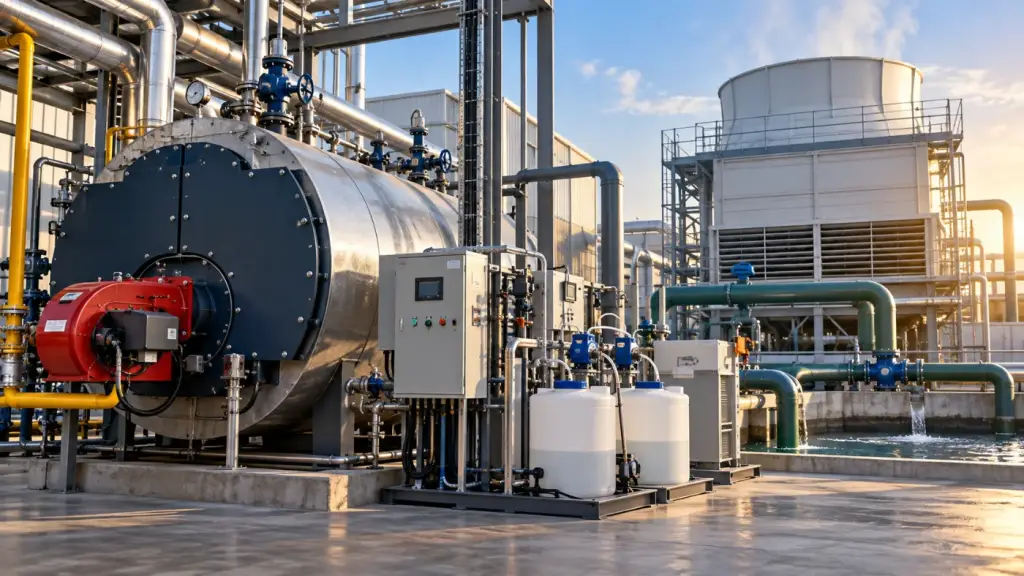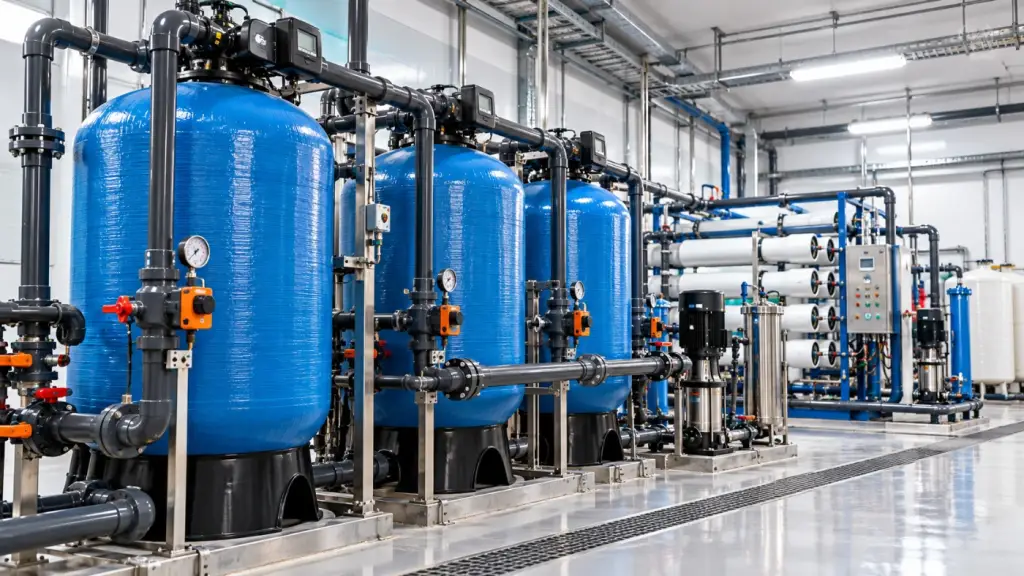
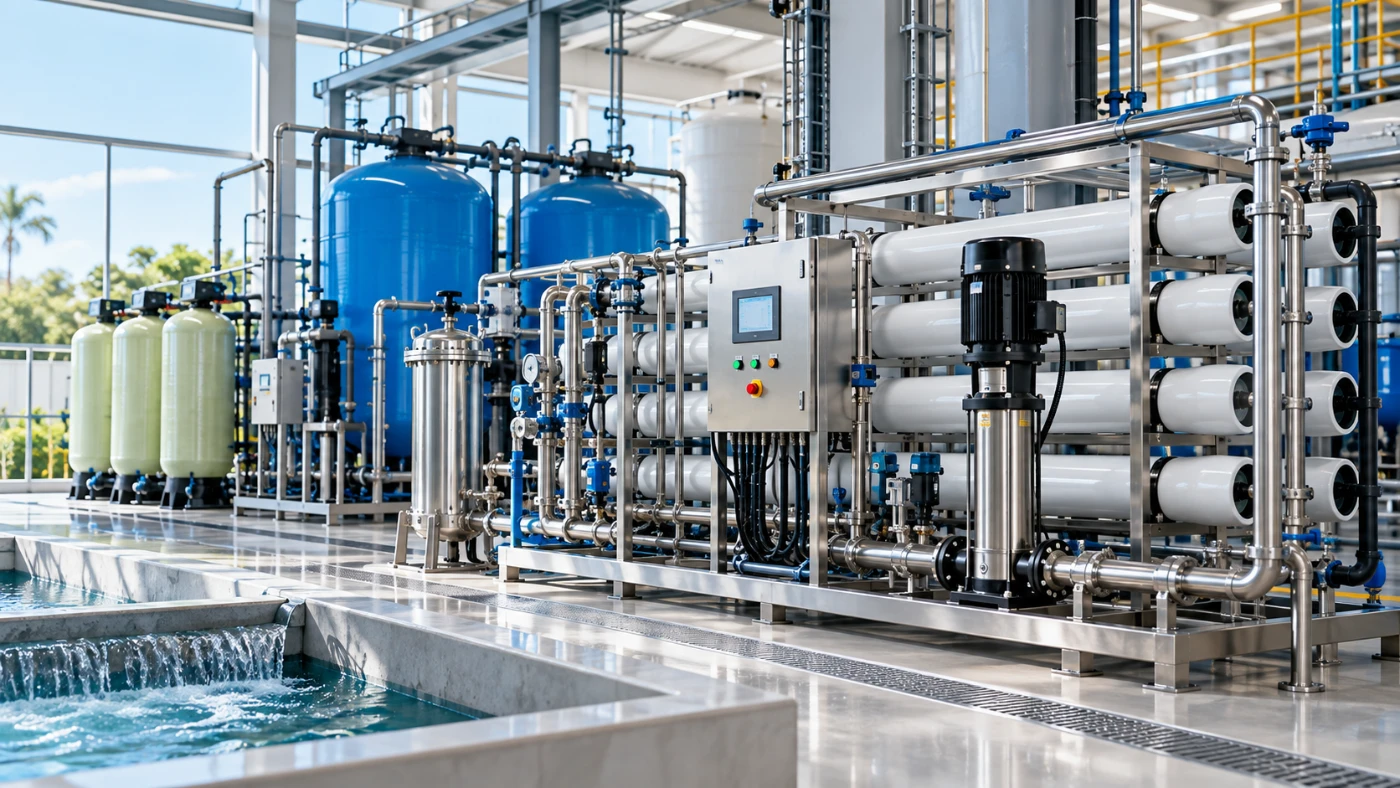
Water treatment plants for factories are systems designed to turn source water (mains, well, sea, or reused water) into water of the quality the industrial use requires. They usually consist of more than one stage: filtration, then removal of hardness or salts, then disinfection. The type and size of the plant are decided by two things: the source water analysis, and the water quality required at the point of use.
What types of industrial water treatment plants and units are there?
| Type | What it removes | When you need it |
|---|---|---|
| Filtration units (sand, carbon, multimedia) | Turbidity, suspended solids, chlorine, odours and iron | As pre-treatment for any plant, or as sufficient treatment for utility water |
| Softeners | Hardness (calcium and magnesium) | Feedwater for boilers, heat exchangers and cooling towers |
| Reverse osmosis (RO) plants | Most dissolved salts | Brackish well water, seawater desalination, low-salinity process water |
| Ion exchange and demineralisation | Salts, down to high levels of purity | High-pressure boilers and the pharmaceutical and electronics industries |
| Disinfection systems (chlorination, UV, ozone) | Bacteria and micro-organisms | Drinking water, food and beverages, and as a final stage |
| Wastewater treatment plants | Pollutants in industrial and sanitary wastewater | Before discharge to the sewer network or reuse |
How do you know which plant your facility needs?
- Analyse the source water: total dissolved solids (TDS), hardness, iron and manganese, turbidity, chlorine, and bacteriological analysis.
- Define the water quality required: boiler feedwater is different from water that goes into the product or cooling water.
- Define the quantity: daily consumption, peak hourly demand and the number of operating hours.
- Choose the least treatment that achieves the required quality: not every facility needs RO; sometimes a filter and a softener are enough.
Example: a factory using well water with high salinity to feed a boiler usually needs filtration followed by RO, and a softener may be added ahead of the boiler. A factory on mains water that needs water for the boiler only may need no more than a carbon filter and a softener with a chemical program.
What does a typical water treatment plant consist of?
- Feed pumps and a raw water tank.
- Pre-treatment: a sand or multimedia filter, a carbon filter, and chemical dosing (chlorine, antiscalant).
- Cartridge filters to protect the stages that follow.
- The main treatment unit: RO membranes, ion exchange columns or a softener.
- Final treatment: pH adjustment and disinfection.
- A control panel and instruments (pressure, flow, conductivity) and a product water tank.
How do you choose a contractor or installation company for water treatment plants?
- A design based on a real water analysis, not on a “ready-made size”. Ask to see the design basis: the analysis, the recovery rate and the expected product water quality.
- A clear scope of work: design, supply, installation, commissioning and training. What is not written in the offer will not be done.
- Component specifications: the type of membranes, pumps and vessels, the piping materials and the degree of automation of the control panel.
- Operating cost, not just purchase cost: electricity, chemicals, cartridge filters, and replacement of membranes or resin.
- Service after start-up: routine maintenance and the availability of spare parts and consumables and operating chemicals from the same company.
- A track record in similar plants that can be verified.
Water treatment plants FAQ
What is the difference between a desalination plant and a treatment plant?
Desalination is one type of treatment, aimed at removing dissolved salts, usually by reverse osmosis. “Water treatment plant” is a broader term that covers filtration, softening, disinfection and wastewater treatment.
Does an RO plant need pre-treatment?
Yes, always. Membranes are sensitive to turbidity, chlorine, iron and scaling, and pre-treatment is what determines their life. Read: How to choose the right RO plant for your facility.
How long does it take to build a water treatment plant?
It varies with the size of the plant, the availability of components and site preparation. The duration is set in the technical offer once the requirements are known.
Can the plant be expanded later?
If this is taken into account at the design stage (space, pump capacities, control panel), expansion becomes easier and less costly.
Summary
The right plant is the simplest system that achieves the required water quality at a reasonable operating cost, built by a company that stays with you after handover. Browse Aqua System’s water treatment services or read about types of industrial water filters.
Want your system reviewed? Contact the Aqua System technical team and send your water analysis if you have one — we will come back with a suitable solution and a clear quotation.