Industrial wastewater treatment is a sequence of physical, chemical and biological stages that remove pollutants from process effluent — such as suspended solids, oils, organic matter and metals — until the water meets discharge requirements or is fit for reuse. No single design suits every factory: a plant is designed from the actual effluent analysis, its flow and where it will be discharged.
How does industrial wastewater differ from sewage?
Sewage comes from domestic use and its characteristics are similar from one site to another, so sewage plants resemble each other. Industrial effluent differs fundamentally between industries: a food plant’s effluent is rich in organic matter and fats, a metal-plating effluent contains heavy metals and acids, and a textile effluent carries dyes and alkalinity. That is why every industrial plant starts with a study of the effluent itself.
What are the key pollution indicators?
| Indicator | What it measures | Why it matters |
|---|---|---|
| pH | Acidity or alkalinity of the effluent | Affects every treatment stage and the sewer network |
| Total suspended solids (TSS) | Undissolved particles | Cause turbidity, deposits and blockages |
| Chemical oxygen demand (COD) | Total chemically oxidisable matter | A fast overall indicator of organic load |
| Biochemical oxygen demand (BOD) | Biodegradable organic matter | Its ratio to COD shows whether biological treatment is viable |
| Oil and grease | Oil and fat content | Hinder biological treatment and block lines |
| Heavy metals | Such as chromium, nickel and zinc | Toxic to living organisms and tightly limited |
What are the stages of industrial wastewater treatment?
1. Preliminary treatment
Screens to catch large objects, a collection and equalisation tank that evens out flow and concentration through the day, and oil and grit separators where needed. The equalisation tank is one of the most important parts of the plant, because industrial effluent arrives in uneven batches.
2. Physico-chemical treatment
pH adjustment with acids or alkalis such as caustic soda and hydrochloric acid, then coagulation and flocculation, where coagulants and polymers gather fine particles and metals into flocs that are removed by settling or by dissolved air flotation (DAF), which suits oils and fats.
3. Biological treatment
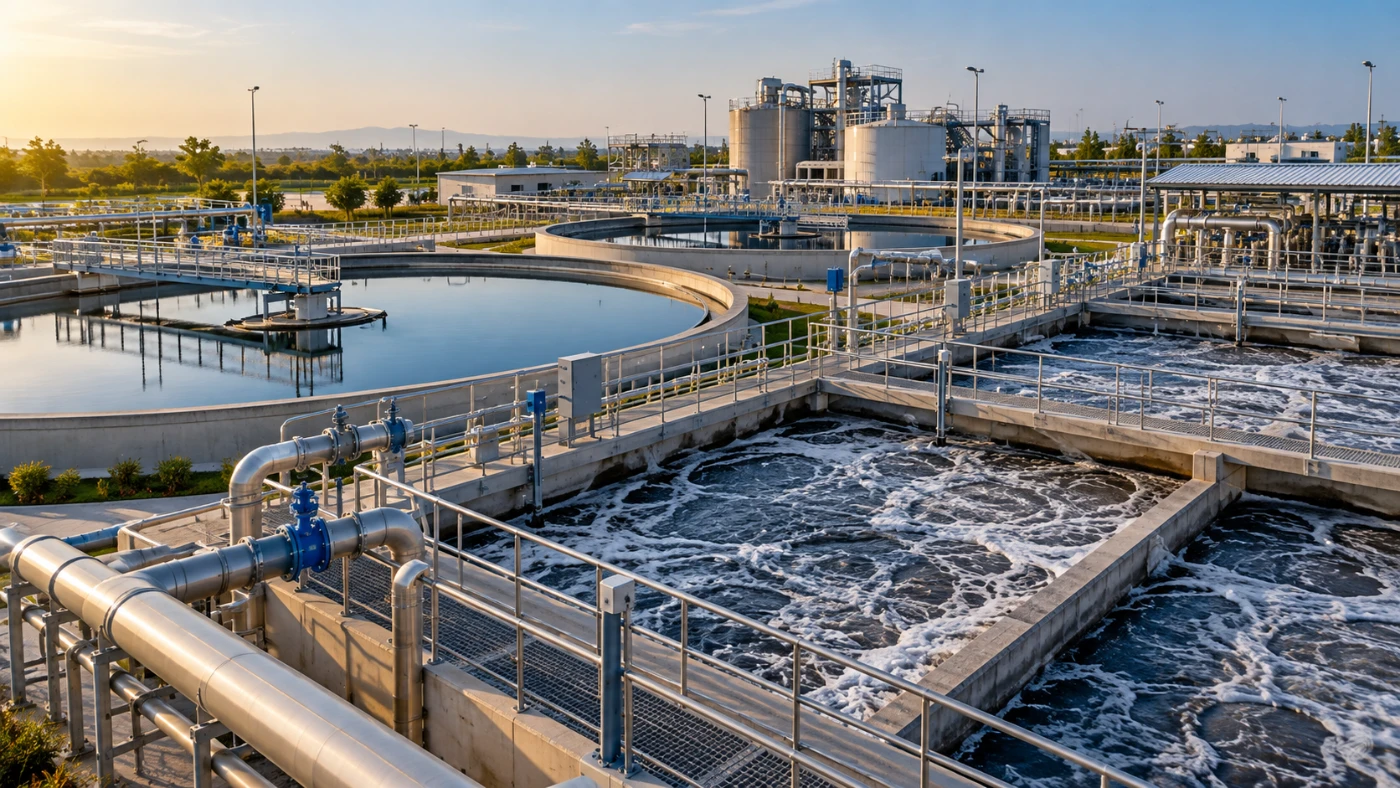
Used when the effluent contains biodegradable organic matter: micro-organisms consume it in the presence of air. Common systems are activated sludge, sequencing batch reactors (SBR), moving bed biofilm reactors (MBBR), and membrane bioreactors (MBR) when high water quality is required or space is limited.
4. Final treatment
Sand or carbon filtration to remove remaining solids and organics, then disinfection with chlorine or ultraviolet light. For reuse in industry a reverse osmosis stage may be added.
5. Sludge handling
The pollutants removed become sludge that needs thickening and dewatering (drying beds or presses) and then safe disposal according to its nature. Neglecting this stage at design is one of the most common reasons plants struggle in operation.
How does the plant differ by industry?
| Industry | Typical effluent | Usual core treatment stages |
|---|---|---|
| Food and dairy | High organic load and fats | Fat separation / flotation, then biological treatment |
| Metal plating and finishing | Heavy metals and acids | pH adjustment and chemical precipitation of metals |
| Textiles and dyeing | Dyes, alkalinity and organics | Chemical coagulation, then biological treatment and sometimes colour removal |
| Oils and petrochemicals | Oils and organic matter | Oil separators and flotation, then biological treatment |
| Pharmaceuticals and chemicals | Varied compounds, some hard to degrade | A custom design after a detailed effluent study |
This table is indicative; the actual design always depends on the analysis of the factory’s own effluent.
What determines the design and cost of an industrial wastewater plant?
- Daily effluent volume and how it is spread over operating hours.
- Effluent analysis: the indicators above, from samples that represent different production days.
- Final discharge point: the public sewer, a waterway, or reuse. Each has its own requirements under the governing Egyptian legislation (such as Law 93 of 1962 and its amended executive regulations for discharge to public sewers, Law 48 of 1982 on protecting the Nile and waterways, and Environment Law 4 of 1994); the limits currently in force should be confirmed with the competent authority before design.
- Available area and the level of automation required.
- Operating cost: power, chemicals, labour and sludge disposal — over the life of the plant, more important than the construction cost.
Can treated industrial wastewater be reused?
Yes, in many cases. Treated water can serve uses that do not need high quality, such as permitted irrigation or washing, and after advanced stages it can return to some industrial uses such as cooling tower make-up. Viability depends on the water quality required and the cost of the extra treatment compared with the cost of fresh water.
Industrial wastewater treatment FAQ
Is chemical treatment alone enough?
It is when the pollutants are mainly suspended solids, metals or oils. If the dissolved organic load is high, biological treatment must follow.
What is the first step in building an industrial wastewater plant?
Measuring the effluent volume, analysing representative samples, and identifying the final discharge point and its requirements. The whole design is built on that data.
Why do some plants struggle after start-up?
Common causes: a design based on an unrepresentative analysis, no adequate equalisation tank, neglected sludge handling, or operation without monitoring chemical doses and test results.
Does a plant need follow-up after handover?
Yes. A plant is a living system affected by changes in production and raw materials; it needs routine testing, dose adjustment and equipment maintenance.
Summary
A successful industrial wastewater plant starts with an accurate effluent analysis and ends with regular operation and follow-up. Learn about Aqua System’s sewage and industrial wastewater treatment plants.
Want your treatment program reviewed? Contact the Aqua System technical team and send your water analysis if you have one — we will come back with a suitable program and a clear quotation.